
Enhanced rock weathering (ERW) is moving from research and pilots into commercial deployment at scale. The first major tranche of deployment-scale carbon removal credits, backed by measurement, reporting and verification (MRV) data from ERW suppliers, has now been issued through the Isometric and Puro.earth registries, under successive versions of their respective Enhanced Weathering in Agriculture and Enhanced Rock Weathering methodologies. Isometric publishes most of the underlying delivery data alongside each CDR claim.
Now that meaningful tonnage is moving through verification, any public, registry-grade data is enormously valuable. Every delivered tonne accompanied by publicly disclosed underlying data sharpens the field’s collective understanding of how ERW deployments behave in the real world.
Mati will soon be adding to this data pool, and we want to take this opportunity to demonstrate why we believe our forthcoming carbon dioxide removal (CDR) claims offer a robust look at weathering rates. In this piece, we walk through some of the challenges in producing ERW carbon removal credits. We also walk through (some of) what we think it takes to make a scientifically and statistically supported CDR claim. We have imposed these expectations on our own work.
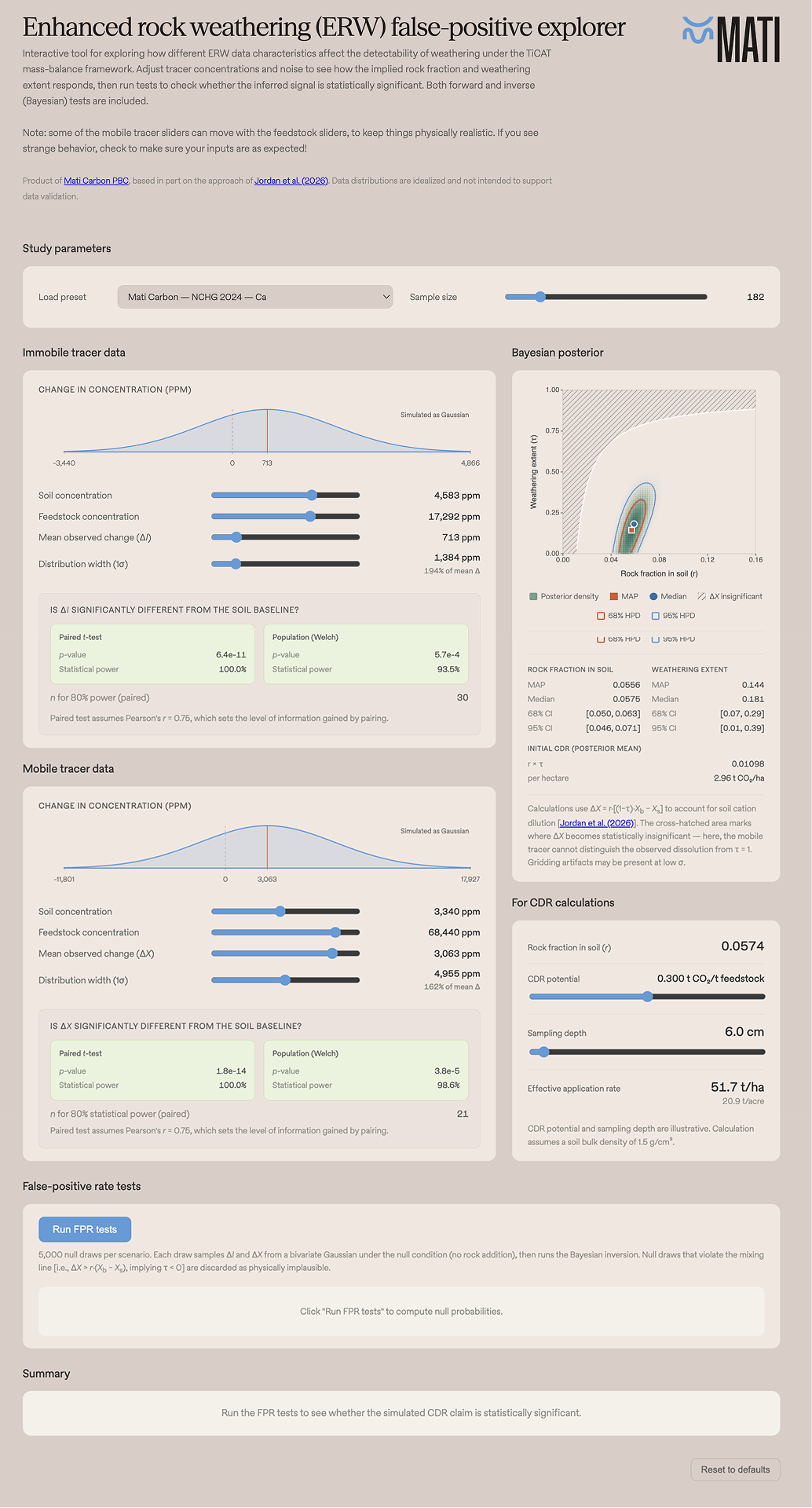
Read more about the tool here – sandbox.maticarbon.com
Code for using your data –https://github.com/Mati-Carbon/Mati_fpr_explorer_tool