
Some years are about building quietly. Others are about proving that what you’ve built truly works. For Mati Carbon, 2025 was unmistakably the latter.
This year, we saw growing validation of our vision to place smallholder farmers at the heart of climate adaptation and mitigation action through durable carbon removal, tested across multiple geographies. This work is beginning to translate into practical gains for livelihoods, resilience and restored agricultural landscapes. What began as an ambitious experiment in enhanced rock weathering, is maturing in 2025 as a credible pathway for durable carbon removal, one that can support farmer incomes while strengthening landscape level resilience.
Across partnerships, funding, science, operations, and people, 2025 marked a decisive shift for us at Mati Carbon from promise to proof.
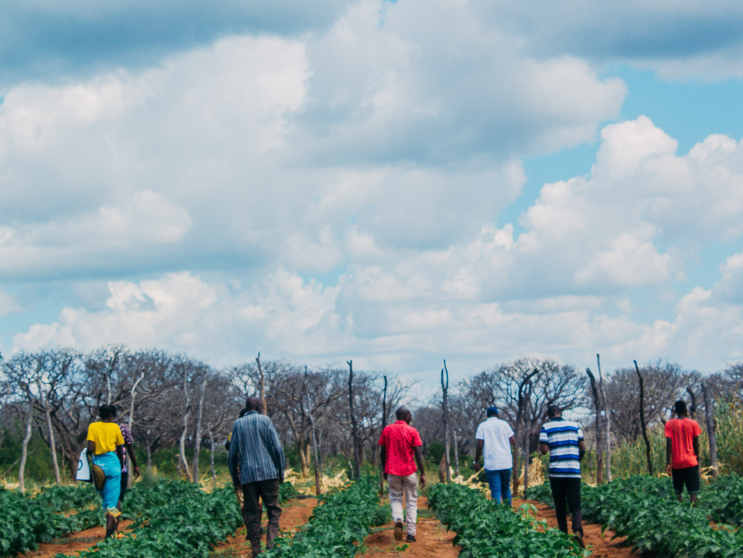
From Early Trust to Market Confidence
We entered the year with a strong signal from the carbon removal market itself. In early 2025, Shopify committed to a 5,000-ton pre-purchase of Mati’s durable carbon removal, reinforcing growing buyer confidence in high-integrity removals that deliver measurable climate and livelihood outcomes.
This commitment reflected something deeper than volume. It affirmed trust in Mati’s end-to-end model, which combines rigorous science, transparent MRV, and direct benefit sharing with smallholder farmers while enriching the soil.
5,000 tons of durable CDR pre-purchased by a global corporate buyer.
Winning the XPRIZE: Proof at Global Scale
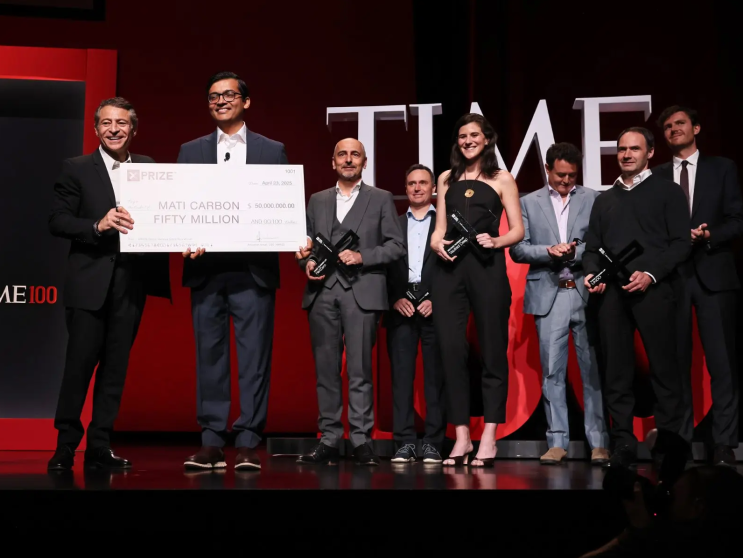
In April 2025, Mati Carbon was named the Grand Prize Winner of the $100 million XPRIZE Carbon Removal global competition, selected from more than 1,300 teams worldwide from 88 countries assessed roughly over a period of 4 years.
The award recognized Mati as the most scalable, cost-effective, and durable carbon removal solution demonstrated at meaningful scale. What made the moment especially powerful, however, was the context of the win. Mati prevailed in a science-led global climate challenge on the strength of its technology and rigorous, scalable MRV, while remaining true to its mission of delivering adaptation and resilience co-benefits for smallholder farmers as a Global South, non-profit-controlled enterprise.
Grand challenges like the XPRIZE are designed to stretch our collective imagination and push the boundaries of what is possible. This win calls on Mati not only to celebrate that ambition, but to steward it responsibly as we scale our impact globally.
Mati Carbon is the $50 million XPRIZE Grand Prize from 1,300+ global teams from 88 countries assessed over nearly four years.
Unlocking Scale with Blended Finance
Following the XPRIZE win, Mati crossed another critical threshold: moving from prize-backed validation to institutional-grade finance.
In mid-2025, JPMorgan Chase structured a blended finance, debt facility for Mati Carbon, supported by catalytic de-risking partners including the Schmidt Family Foundation. This structure enables Mati to scale deployments responsibly bridging the timing gap between upfront field deployment costs and multi-year carbon removal credit issuance.
This deal marked one of the earliest uses of blended finance in the emerging durable carbon removal sector, and also a first from a global financial institution in a global south smallholder resilience context.
Advancing Science for Durable Carbon Removal
Throughout 2025, Mati’s research teams produced and shared new empirical data supporting the viability of enhanced rock weathering in tropical and subtropical regions with academic collaborators and partnered smallholder farmers. Mati contributed to peer-reviewed publications, technical reports and conference proceedings to advance the understanding of monitoring, reporting and verification (MRV) techniques and the downstream effects of ERW.
Work lead by Mati researchers was presented at European Geosciences Union Annual Meeting, ERW25, the Goldschmidt Conference of the Geochemical Society, Royal Society of London and the American Geophysical Union Fall meeting. At their core, these contributions drew on the operational experience and data from one of the largest ERW projects globally.
Scaling a world-class and locally-led Team Behind the Mission
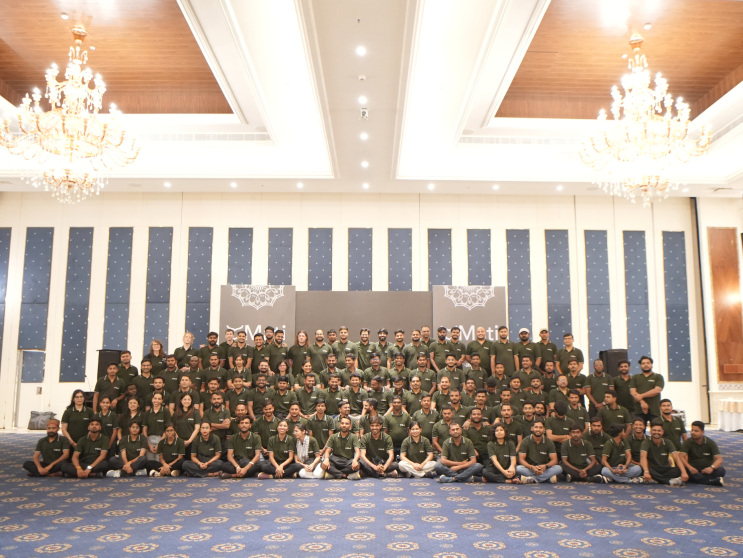
As Mati’s operations expanded, so did the organization supporting them. By mid-2025, our team had grown to more than 120 members spanning field operations, science, logistics, data systems, and community engagement.
This young driven organisation came together during our second full organizational retreat in August this year for a moment to pause, reflect, and recognize the people behind the work. Many of our field leaders come from the same communities we serve, bringing local trust, knowledge and leadership that no technology alone could replace.
120+ team members across science, product, operations, and farmer engagement.
Expanding Beyond India: New Geographies, New Science & Local Partnerships
While India remains Mati’s largest operational base, 2025 marked a major step in geographic expansion. We expanded our trials in Tanzania and Zambia from last year, and initiated new field trials and MRV development in two countries in Africa and one in Asia. These new regions were developed in partnership with the local research institutions – a fundamental ethos in our approach to drive science-based locally-led adaptation. Each new region represents the scientific investment of building agro-ecology-specific MRV systems before scaling. This ensures permanence claims remain robust across soils, climates, and cropping systems.
6+ countries with active deployments or trials; multiple new agro-ecological zones under MRV development.
Measurable Farmer Impact at Scale
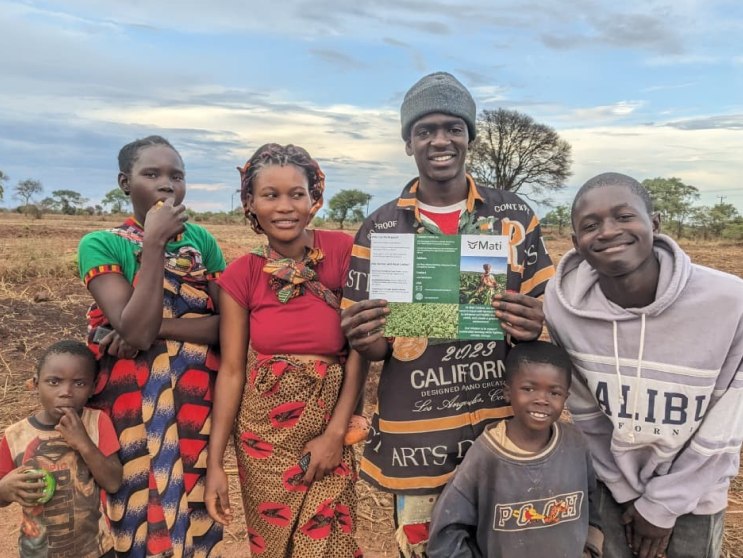
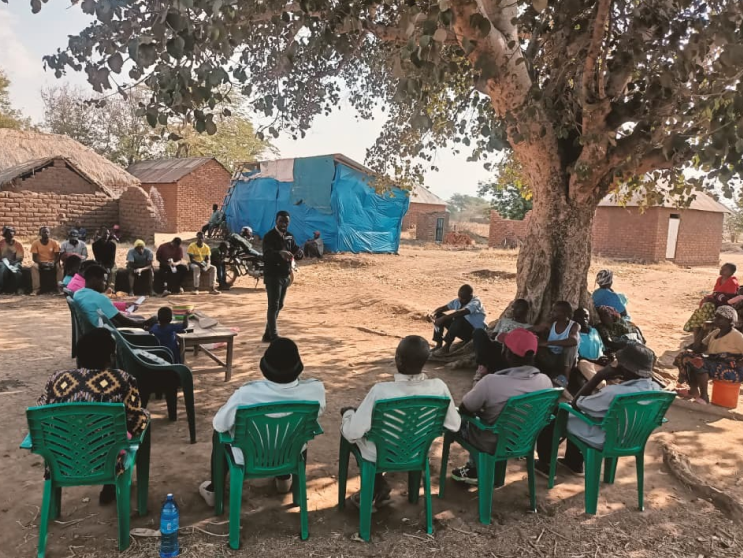
At the end of 2025, Mati Carbon had worked across 500+ villages, engaging 30,000+ smallholder farmers through community meetings, field trials, deployments and MRV development across India, Africa, and Southeast Asia. Across deployed regions, enhanced rock weathering delivered clear agronomic and economic outcomes. Farmers saw average yield improvements of 15–25%, alongside improved soil health and reduced reliance on chemical inputs and improved water retention capacity. These gains translated directly into income, debt reduction and improved economic security. In aggregate, Mati estimates that partner farmers realized several million dollars in additional on‑farm income in 2025 alone.
Importantly, this impact was delivered at no cost to farmers. All basalt application, logistics, and monitoring were funded through climate finance, enabling immediate benefits for farmers while contributing to durable global carbon removal.
Global Recognition – TIME100 Next, Forbes Sustainability Leaders
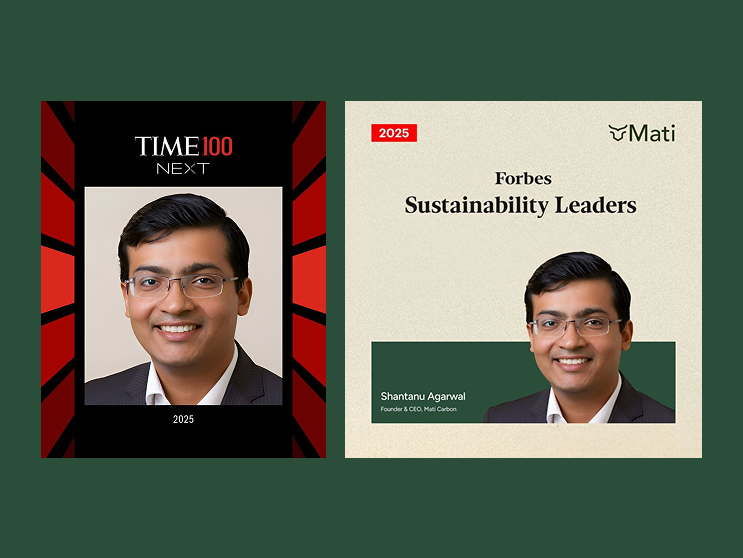
In September 2025, Forbes named Mati’s leadership among the world’s Top 50 Sustainability Leaders, placing Mati alongside a small group of global changemakers advancing solutions that are climate-positive, economically viable, and socially transformative.
Later, Mati’s work reached a broader audience when it was featured in TIME100 Next, recognizing leaders shaping the future across science, technology, and society.
Independent Validation of MRV Science Integrity
Toward the end of the year, Mati achieved another milestone: a prestigious AA pre-rating from BeZero, the first project of its kind in India to receive this distinction from a global leader in providing scientific ratings for the carbon credits sector. The rating reflects confidence in Mati’s durability claims, MRV rigor, governance, and long-term climate impact—providing independent validation for buyers and partners.
AA pre-rating — first ever for an ERW project and for an Indian project.
The Year in Perspective
By the close of 2025, Mati Carbon had reached a new level of maturity:
But perhaps most importantly, 2025 showed that climate action, landscape restoration and farmer prosperity can reinforce each other when designed for real world conditions.